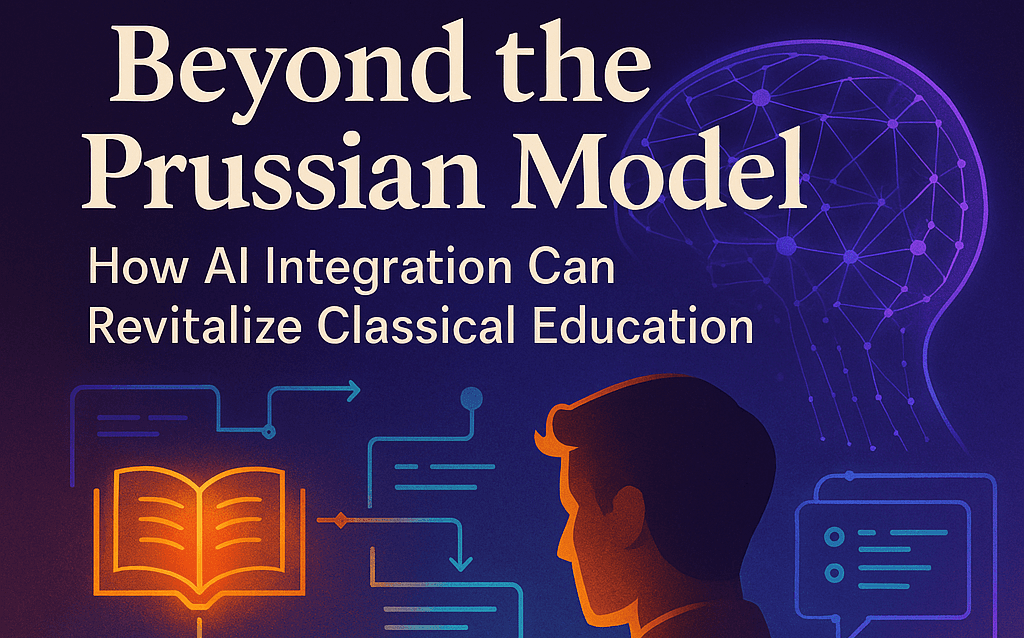
Beyond the Prussian Model: How AI Integration Can Revitalize Classical Education
Keith Williams
TheoForge
Beyond the Prussian Model: How AI Integration Can Revitalize Classical Education
Policy Brief for Educational Leadership
The pressing challenge facing educational leadership today isn't whether AI will transform education—it's whether this transformation will be strategic and deliberate or reactive and haphazard. As a university professor with over 20 years of classroom experience and extensive background in software engineering, I've observed firsthand how our educational system struggles with dual challenges: an outdated industrial model and increasing cognitive erosion among students.
This policy brief outlines how institutional leaders can implement an Educational Renaissance approach that blends classical educational ideals with AI augmentation, addressing both challenges simultaneously.
The Case for Educational Renaissance
Historical Context: The Limitations of the Prussian Model
Our current educational system remains fundamentally rooted in the 19th-century Prussian model—a standardized, age-based framework designed primarily to produce obedient citizens and industrial workers. While this model effectively scaled basic education during the industrial revolution, research increasingly demonstrates its inadequacy for modern needs:
- Declining Effectiveness: Despite increasing financial investment in K-12 education, academic outcomes have plateaued or declined
- Parental Dissatisfaction: Recent surveys show a majority of parents believe the system is "off track" and failing to develop critical thinking skills
- Employer Feedback: 70% of business leaders report skills gaps in their workforce, particularly in higher-order cognitive abilities
- Economic Impact: By 2030, skills shortages could cost the U.S. economy $8.5 trillion
Cognitive Challenges in the Digital Era
Simultaneously, research documents concerning patterns of cognitive skill erosion among students:
- The "Google effect" on memory, where students no longer internalize knowledge readily available online
- Diminished spatial reasoning abilities from overreliance on GPS and navigation tools
- Reduced writing proficiency and attention to detail from dependency on autocorrect and spell-checkers
- Shortened attention spans affecting sustained reading and complex argumentation
The Educational Renaissance Framework
Our research proposes a framework that doesn't merely add technology to classrooms but fundamentally reimagines education by blending classical ideals with AI capabilities:
1. Classical Education Principles
- Reasoning: Developing logical thinking and analytical abilities
- Eloquence: Mastering clear, persuasive communication
- Virtue: Cultivating character, ethics, and civic responsibility
2. AI Augmentation Strategies
- Administrative Efficiency: Automating routine tasks to free educator time
- Personalized Socratic Dialogue: Scaling mentorship through AI tutoring
- Cognitive Skill Development: Using technology to strengthen rather than replace thinking abilities
Implementation Guide for Institutional Leaders
Governance and Policy Development
1. Institutional Assessment
- Evaluate current manifestations of the Prussian model in your systems
- Identify specific areas of cognitive skill erosion within your student population
- Assess teacher workload distribution and administrative burden
- Review existing technology infrastructure and data governance
2. Policy Framework Creation
- Develop clear guidelines for ethical AI use in educational contexts
- Establish data privacy and security protocols specific to AI implementation
- Create governance structures that balance innovation with appropriate oversight
- Design equitable access policies to prevent new forms of educational divides
3. Budget and Resource Allocation
- Analyze potential ROI on AI implementation (teacher retention, improved outcomes)
- Develop multi-year funding strategies that account for both technology and training
- Consider consortium approaches to share development costs with peer institutions
- Establish metrics for measuring both financial and educational returns
Educational Implementation
1. Curriculum Redesign
- Identify areas where classical educational principles can be enhanced by AI
- Develop frameworks for integrating Socratic dialogue at various educational levels
- Create balance between technology-assisted and technology-free learning experiences
- Design assessments that measure both content mastery and cognitive skill development
2. Professional Development
- Train educators in effective AI collaboration rather than just tool usage
- Develop competencies in oversight and evaluation of AI-assisted learning
- Create communities of practice to share implementation successes and challenges
- Establish career advancement pathways for educators who excel in the hybrid model
3. Student Engagement
- Develop age-appropriate AI literacy curriculum across all grade levels
- Create frameworks for teaching responsible AI usage and critical evaluation
- Implement cognitive resilience training alongside AI tool introduction
- Design student feedback mechanisms to continuously improve implementation
Case Studies: Early Success Indicators
1. Collegiate Implementation A randomized study at Stanford found that students using AI tutoring systems learned twice as much material in half the time compared to traditional active learning classes. Key success factors included:
- Clear delineation between AI and human teaching responsibilities
- Focused use of AI for Socratic questioning rather than direct answers
- Regular human-led discussions of AI-assisted learning experiences
2. K-12 Application A World Bank pilot in Nigeria demonstrated that six weeks of AI tutoring produced learning gains equivalent to two years of traditional instruction. The program:
- Reduced gender achievement gaps by providing personalized feedback
- Leveraged AI for basic skill practice while teachers focused on higher-order thinking
- Created a scalable model adaptable to various resource constraints
3. Teacher Impact Early implementations show 25-35% reductions in administrative workload when AI systems handle routine tasks such as:
- Basic assessment grading and feedback
- Resource compilation and curriculum alignment
- Parent communication management
- Student progress tracking and pattern identification
Strategic Recommendations for Educational Leaders
As an educational leader navigating this transformation, consider these strategic priorities:
1. Pilot-to-Scale Methodology
- Begin with contained pilots that address specific institutional pain points
- Implement robust measurement frameworks to document outcomes
- Create mechanisms for adaptation based on implementation learnings
- Develop phased scaling plans with appropriate governance evolution
2. Stakeholder Engagement
- Proactively engage parents regarding the educational philosophy behind implementation
- Create educator advisory councils to guide technology integration
- Develop student feedback mechanisms appropriate to age levels
- Establish regular communication with community and industry partners
3. Equity-Focused Implementation
- Ensure technology access across socioeconomic demographics
- Monitor implementation results for differential impacts
- Develop specific strategies for traditionally underserved populations
- Create accountability measures for equitable outcomes
Conclusion: Leading the Educational Renaissance
The shift from an industrial-era educational model to an Educational Renaissance represents perhaps the most significant leadership opportunity of our generation. By thoughtfully integrating AI capabilities with classical educational ideals, superintendents and university presidents can address both the limitations of the Prussian model and the cognitive challenges of the digital age.
The institutions that thrive in the coming decade will be those that move beyond viewing AI as merely another educational technology and instead leverage it as a catalyst for fundamental educational transformation—creating systems that are both more effective and more deeply human.
At Bthecause, our team combines my educational technology expertise with Michael B. Minor's human-centered approach to develop customized implementation strategies for forward-thinking institutions. Contact us to discuss how we can support your educational renaissance journey.